
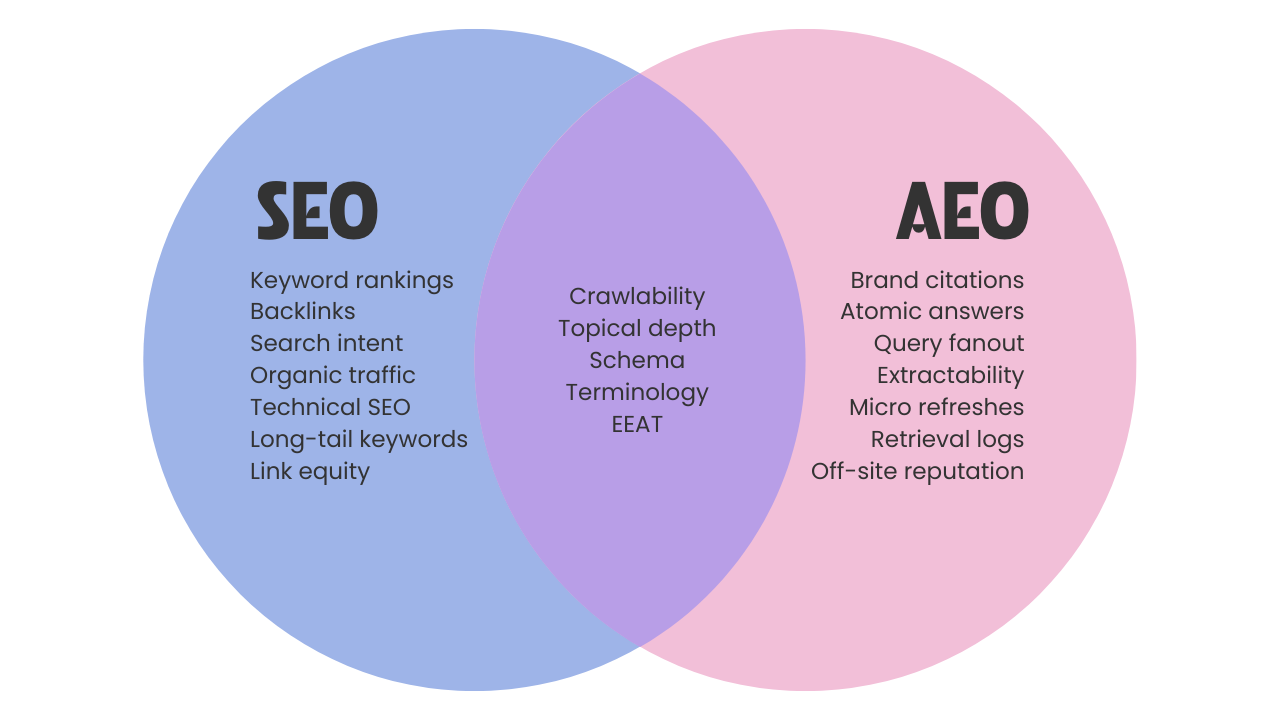
What Is the Difference Between SEO and AEO?
Search discovery is evolving rapidly, creating new challenges for B2B SaaS content marketers. While traditional SEO continues generating sustainable organic traffic through Google rankings, emerging AI-powered search tools are capturing user queries before they reach your website.
Bottom Line: Modern content strategy requires both SEO for direct website traffic and AEO for visibility in AI-generated responses.
Google’s AI Overviews, ChatGPT search, Perplexity, and similar answer engines now intercept informational searches and deliver synthesized responses instead of directing users to click through to your content. This shift means “ranking” now includes being featured, cited, or recommended within AI-generated answers.
Successful B2B SaaS companies need a dual approach: SEO for sustainable traffic growth and AEO for brand presence in the AI-powered search ecosystem.
Understanding SEO: Traditional Search Engine Optimization
What Is SEO?
Search engine optimization (SEO) involves optimizing web content to achieve higher rankings in traditional search engine results pages (SERPs). The primary goal is earning qualified organic traffic through improved visibility in Google’s standard “blue link” listings.
How SEO Works for B2B SaaS
Traditional SEO focuses on:
- Keyword targeting: Optimizing pages for specific search terms
- SERP positioning: Competing for top 10 search result placements
- Click-through rates: Encouraging users to visit your website
- Conversion optimization: Turning organic visitors into qualified leads
Understanding AEO: Answer Engine Optimization
What Is AEO?
Answer engine optimization (AEO) prepares content for AI-powered search systems that generate direct responses rather than providing clickable links. These systems extract information from multiple sources to create comprehensive answers.
How AEO Impacts B2B SaaS Marketing
AEO optimization targets:
- Content extraction: Making information easily extractable for AI systems
- Citation inclusion: Getting mentioned within AI-generated responses
- Brand attribution: Ensuring proper credit when content is synthesized
- Conversational follow-ups: Supporting multi-turn search conversations
SEO vs AEO: Comprehensive Comparison
| Aspect | SEO (Search Engine Optimization) | AEO (Answer Engine Optimization) |
|---|---|---|
| Primary Goal | Achieve higher rankings in traditional SERPs to drive website traffic | Get content cited and featured in AI-generated responses and answer engines |
| User Journey | Users click through to websites for detailed information | AI systems provide direct answers without requiring clicks |
| Content Structure | Keyword-optimized content with natural flow and internal linking | Atomic answers that work as standalone, extractable fragments |
| Success Metrics | Rankings, organic traffic, click-through rates, conversions | Citations in AI responses, brand mentions, accuracy of extraction |
| Update Frequency | Quarterly or annual content refreshes | Monthly updates with fresh data and timestamps |
| Discovery Method | Users search, review results, click through to sites | AI systems extract and synthesize information from multiple sources |
| Content Format | Long-form, detailed content with strategic keyword placement | Structured formats: FAQs, definition blocks, comparison tables |
| Trust Signals | Backlinks, domain authority, traditional SEO metrics | Multi-source validation, structured credibility signals |
| Technology Focus | Traditional algorithms, mobile-first indexing, Google updates | Natural Language Processing, AI systems, knowledge graphs |
| Traffic Pattern | Direct website visits and engaged sessions | Indirect brand exposure through AI citations |
| Keyword Strategy | Short-tail, exact-match, and informational keywords | Natural language, question-based, conversational queries |
| Content Length | Comprehensive, in-depth articles and pages | Concise, direct answers with supporting context |
Key Differences: SEO vs AEO
Discovery and Traffic Patterns
SEO Discovery Method Users enter search queries, review results pages, and click through to websites for detailed information.
AEO Discovery Method AI systems analyze user questions, extract relevant information from multiple sources, and present synthesized answers directly within the search interface.
Content Structure Requirements
SEO Content Structure Content flows naturally with keyword integration, internal linking, and user engagement optimization.
AEO Content Structure Content must work in extracted fragments with atomic answers that remain accurate outside their original context.
Performance Measurement
SEO Success Metrics
- Search engine rankings for target keywords
- Organic website traffic volume
- Click-through rates from SERPs
- Lead generation and conversion rates
AEO Success Metrics
- Citations in AI-generated responses
- Brand mentions across answer engines
- Accuracy of extracted information
- Indirect traffic attribution
Content Maintenance
SEO Update Schedule Quarterly or annual content refreshes typically maintain ranking performance.
AEO Update Schedule Monthly updates with fresh data, recent examples, and current timestamps improve selection probability.
Shared Requirements: SEO & AEO Similarities
| Shared Requirements | How Both SEO and AEO Benefit |
|---|---|
| Technical Infrastructure | Clean URLs, fast loading times, crawlable pages, proper sitemaps work for both traditional search engines and AI systems |
| Content Quality | High-quality, authoritative content with topical expertise builds trust with both Google’s algorithms and AI confidence scoring |
| Trust Signals | Expert authorship, credible sources, and recent data validate content for both traditional rankings and AI citations |
| Information Architecture | Clear site structure helps both Google’s crawlers and AI systems understand content relationships and context |
| Schema Markup | Structured data feeds both Google’s knowledge graph and AI systems, improving visibility in both environments |
| Mobile Optimization | Mobile-friendly design is required by both traditional search algorithms and mobile-first AI search experiences |
Similarities Between SEO and AEO
Shared Technical Infrastructure
Both SEO and AEO require identical technical foundations. Crawlable websites with clean URL structures, comprehensive sitemaps, and optimized page speeds benefit both traditional search engines and AI systems.
Information architecture that helps Google understand topic relationships also enables AI systems to map content context and relevance effectively.
Content Quality Standards
High-quality content performs well in both environments. Topical authority becomes even more critical for AEO since AI systems favor sources demonstrating comprehensive subject matter expertise.
Domains that consistently cover topics from multiple perspectives with original insights earn repeated citations from AI systems, while isolated pages rarely achieve AI visibility.
Trust and Authority Signals
Both SEO and AEO value similar credibility indicators:
- Expert authorship: Named authors with visible credentials
- Primary source data: Recent statistics from authoritative sources
- Expert validation: Quotes and insights from industry leaders
- Structured markup: Schema that organizes information for machine reading
AEO-Specific Optimization Requirements
Creating Extractable Content Structure
AI systems work with content fragments, requiring specific structural approaches that differ from traditional SEO writing.
Atomic Answer Format Each section must contain complete, standalone responses. Begin major sections with direct answer sentences that mirror section headings. These sentences should fully address the question even when extracted without surrounding context.
Intent Constellation Development Build comprehensive hub pages that address primary questions alongside related sub-questions. This approach supports conversational search patterns where users ask follow-up questions or reformulate their original queries.
Machine-Readable Formatting Organize information using:
- FAQ sections with clear question-answer pairs
- Definition blocks for key terminology
- Comparison tables highlighting differences
- Numbered process steps for procedural content
- Bulleted lists for feature sets and benefits
Freshness and Content Maintenance
AI systems prioritize current information more aggressively than traditional search algorithms.
Regular Update Cycles Implement monthly content refreshes with updated statistics, recent product developments, and current market conditions. Include visible “Last updated” timestamps and change documentation.
Recency Signal Integration Add year tags to critical data points, include recent expert quotes, and maintain statistics no older than three years. Current information signals reliability to AI confidence scoring mechanisms.
External Validation Strategy
AEO success requires multi-source corroboration since AI systems verify claims across multiple sources before inclusion in synthesized answers.
Systematic Off-Site Development
- Contribute expertise to industry forums and discussion platforms
- Maintain current profiles on relevant business directories
- Encourage and facilitate customer review generation
- Participate actively in community discussions
Structured Credibility Building Prioritize mentions in expert roundups, citations in industry research reports, and discussions on platforms like Reddit, G2, and specialized forums where AI systems commonly source training data.
How to Implement SEO and AEO Together
Content Audit and Gap Analysis
Current State Assessment Test your primary business queries in ChatGPT, Perplexity, and Google’s AI Overviews. Document competitor citations and identify content gaps where rivals appear but your brand doesn’t.
Optimization Priority Setting Focus initial efforts on queries directly related to your product category, core features, and competitive advantages. AI citations for these strategic topics directly influence purchase decisions and brand consideration.
Content Development Workflow
Hub Page Creation Develop comprehensive resource pages that address one primary business question plus 8-12 related sub-questions. This hub-and-spoke approach outperforms single-focus content in conversational search environments.
Content Refresh Systems Create systematic rotation schedules for updating your most strategic pages. Track content age and implement monthly mini-updates with fresh examples, current statistics, and updated timestamps.
Performance Monitoring
AI Citation Tracking Establish regular monitoring of major AI search tools for your key business queries. Document citation frequency, accuracy of representation, and competitor presence. This manual tracking currently provides the most reliable AEO performance insights.
Traditional SEO Baseline Continue monitoring standard SEO metrics including rankings, organic traffic, and conversion rates. AEO optimizations should enhance, not compromise, traditional search performance.
Frequently Asked Questions
What is AEO compared to SEO?
AEO optimizes content for AI-powered answer engines that provide direct responses, while SEO focuses on traditional search rankings. AEO targets citation inclusion in AI-generated answers, whereas SEO drives traffic through clickable search results to websites.
What is an example of AEO?
When you search “How to change a bicycle tire?” AEO-optimized content appears as step-by-step instructions directly in AI responses or Google’s AI Overview, providing immediate answers without requiring users to click through to the original website.
What does AEO mean in marketing?
Answer Engine Optimization (AEO) is the practice of structuring content so AI systems can easily extract and cite information in synthesized responses, ensuring brand visibility in ChatGPT, Perplexity, and Google’s AI Overview features.
How to implement AEO in website?
Structure content with atomic answers, use FAQ sections, add schema markup, maintain fresh timestamps, and create extractable passages. Focus on clear question-answer pairs and ensure each section works independently when extracted by AI systems.
What is AEO and how does it work?
AEO optimizes content for AI answer engines by creating easily extractable information. AI systems scan multiple sources, identify credible answers, and synthesize responses that cite your content, increasing brand visibility without direct website visits.
Will AEO replace SEO?
No, AEO complements rather than replaces SEO. Traditional search still drives significant traffic, while AEO captures informational queries answered by AI. Successful strategies combine both approaches for comprehensive search visibility across all platforms.
What is the difference between SEO and AEO?
SEO optimizes for traditional search rankings and website clicks, while AEO optimizes for inclusion in AI-generated answers. SEO focuses on traffic generation; AEO focuses on content extraction and citation by answer engines.
Is AEO better than SEO?
Neither is better—they serve different purposes. SEO drives direct traffic and conversions, while AEO builds brand authority through AI citations. B2B SaaS companies need both strategies to maintain visibility across evolving search landscapes.
How to optimize for AEO?
Create structured content with clear headers, use FAQ formats, add recent timestamps, implement schema markup, and write atomic answers that make sense when extracted. Focus on question-based keywords and maintain content freshness.
What is AEO in terms of SEO?
AEO is an extension of SEO that adapts content optimization for AI-powered search systems. While SEO targets traditional rankings, AEO ensures content gets selected and cited by answer engines like ChatGPT and Google’s AI Overview.
How to rank on AEO?
Focus on creating authoritative, structured content with clear answers, maintain content freshness, use schema markup, build external validation through mentions and citations, and optimize for conversational search queries that AI systems commonly address.
What is AEO like SEO?
Both require high-quality content, technical optimization, and authority building. The difference lies in content structure—AEO needs extractable fragments and atomic answers, while SEO can use flowing narrative content with keyword optimization throughout.
The Future of Search: Preparing for Both Worlds
The evolution toward AI-powered search doesn’t eliminate traditional SEO’s value but adds a new dimension to content optimization. B2B SaaS companies that excel in both approaches maintain visibility regardless of how their target audience chooses to search.
Implementation Priority: Begin with strong SEO fundamentals, then add AEO elements like structured answers, regular content updates, and external validation signals.
Companies that master this dual approach position themselves for sustained growth as search technology continues evolving. Those that ignore AEO optimization risk losing visibility to competitors who understand how to succeed in AI-powered search environments.
Ready to optimize your content for both traditional search and AI answer engines? Start with your highest-performing SEO content and add extractable elements that work in both environments.