AI tools now intercept a significant and growing share of informational searches. When someone asks ChatGPT “what’s the best way to structure a blog post for SEO,” they’re not getting a list of links – they’re getting a synthesized answer drawn from sources the model decided to trust. If your content isn’t in that answer, you don’t exist for that query.
That shift is real. But the panic around it isn’t warranted. After twelve years in SEO, I’ve watched enough “everything changes now” moments to know that the fundamentals almost never actually change – only the mechanism does. LLM SEO is no different. It’s not a new discipline bolted onto your existing process. It’s a validation that rigorous, structured, authoritative content was always the right approach.
This guide explains how LLMs find and rank content, what signals actually drive citation, and exactly what to implement on your site this week. I’ve been building these optimizations on this site as I go – so everything here is something I’ve done, not just something I’ve read about.
Key Takeaways
- LLM SEO is good SEO done right – structured, authoritative, fresh, and genuinely useful content was always the correct approach.
- The RAG retrieval pathway is where most of your optimization effort should go; you can’t directly control training data, but you can control indexability and freshness.
- E-E-A-T signals are the primary citation filter – build them on-site (schema, author identity, structured content) and off-site (brand mentions, bylines, LinkedIn).
- Technical foundation – schema markup, llms.txt, Bing indexing – can be implemented in one afternoon and produces durable results.
- GA4 already captures LLM referral traffic; set up source-level tracking now before the volume grows.
What Is LLM SEO?
LLM SEO covers a cluster of related concepts – AEO, GEO, AI search optimization – that all describe essentially the same shift. Here’s how to tell them apart and what actually matters for your strategy.
The One-Sentence Definition (and Why It’s More Useful Than the Long One)
LLM SEO is the practice of optimizing your content to be retrieved, cited, and accurately represented by large language models in AI-generated responses.
That’s the whole definition. It’s worth resisting the urge to make it more complicated. There’s no equivalent of “ranking on page 2” in LLM responses – you’re either cited or you’re not. The goal is inclusion and accuracy, not position.
LLM SEO, AEO, and GEO: What’s the Difference?
These three terms overlap enough that conflating them is understandable. Here’s a clean breakdown:
- LLM SEO: Optimizing specifically for citation by large language models – ChatGPT, Claude, Gemini, Perplexity
- AEO (Answer Engine Optimization): Optimizing for direct answers in search results, including Google AI Overviews – this is the broader category that LLM SEO sits within
- GEO (Generative Engine Optimization): Often used interchangeably with LLM SEO; technically emphasizes the generative AI context specifically
In practice, the tactics for all three overlap significantly. Don’t spend energy on the taxonomy. The underlying principle – structured, authoritative, citable content – applies to all of them.
| Signal | Traditional SEO | LLM SEO | Success Metric | Position 1-10 on SERP | Cited vs. not cited |
|---|---|---|
| Ranking Signal | Backlinks, on-page keywords | Brand mentions, E-E-A-T, structure | Content Format | Keyword-optimized prose | Structured, parseable, quotable |
| Authority Signal | Backlinks | Backlinks + unlinked brand mentions | Measurement | Rank tracking, organic traffic | Citation share, LLM referral traffic |
| Timeline | 3-6 months for ranking movement | Ongoing; training data lags months |
How LLM SEO Differs from Traditional SEO
Key insight
The differences are real but less dramatic than most coverage implies. What stays the same: quality content, authoritative sources, structured markup, and topical depth. These were never optional, and they’re still not.
What genuinely changes:
- Success metric: Position 1-10 becomes citation vs. not cited
- Authority signal: Backlinks still matter, but brand mentions without links now carry real weight
- Content format: Structured, parseable, machine-readable content is rewarded over prose-heavy writing. You can publish a machine-readable copy of your whole site with the free OKF Generator.
- Freshness: Content older than a few months is actively deprioritized by RAG-based retrieval – not just a nice-to-have signal
- Measurement: Share of voice and citation tracking replace rank tracking as primary LLM performance metrics
How LLMs Actually Find and Use Your Content
Most LLM SEO guides skip the mechanism. That’s a mistake – understanding how LLMs retrieve content is what separates practitioners making real changes from those cargo-culting tactics they saw in a LinkedIn post.
The Training Data Pathway
When a language model is trained, it processes massive crawls of the web. Content that was widely indexed, frequently cited, and considered authoritative at training time gets embedded into the model’s base knowledge.
The practical implication: older, established, frequently-linked content has an inherent advantage in the training data pathway. This is why Wikipedia dominates LLM responses for factual queries – not because anyone optimized Wikipedia for ChatGPT. The model learned from the same signals Google uses to rank content.
You can’t directly control what’s in any model’s training data. But building the kind of content that historically gets linked and cited – original research, definitive guides, expert analysis – is the long-term play. For a deeper look at how brand mentions in training data work, I’ve covered the specific tactics in a separate post on getting your brand into LLM training data.
The Live Retrieval (RAG) Pathway
Retrieval-Augmented Generation (RAG) is a mechanism that lets LLMs supplement their base training with real-time web content. When ChatGPT searches the web, when Perplexity generates a cited response, when Google’s AI Overview pulls current information – that’s RAG in action.
This is where most of your LLM SEO effort should focus, because you can directly influence it.
Three things RAG systems care about: indexability (can their crawler reach and parse your content?), freshness (when was this last updated?), and structure (can the retrieval system extract a clean, quotable answer?).
The Bing index matters more than most SEOs realize – 87% of SearchGPT citations match Bing’s top 10 organic results. (Seer Interactive) ChatGPT’s web search runs on Bing, not Google. If you’ve been ignoring Bing Webmaster Tools, that’s the first thing to fix.
Why Both Pathways Inform Your Strategy
You have limited control over training data and significant control over RAG eligibility. That means the tactics in this guide – schema markup, fresh dates, structured content, Bing indexing – are primarily targeting the RAG pathway.
Off-site signals (brand mentions, backlinks, third-party citations) feed both pathways. They influence what the training data says about you AND what RAG retrieval systems surface when queried about your topic.
The strategy is layered: fix the RAG signals now, build the off-site authority over time.
What LLMs Look for When Deciding What to Cite
LLMs don’t cite randomly. They apply quality filters that map almost exactly to Google’s E-E-A-T framework – and that’s not a coincidence.
E-E-A-T Is the Underlying Citation Mechanism
E-E-A-T – Experience, Expertise, Authoritativeness, Trustworthiness – was developed by Google to describe what high-quality, trustworthy content looks like. LLMs, trained heavily on Google-indexed content, have internalized those same signals.
This means the work you’ve already done to demonstrate expertise on your site – author bylines, named client experience, credentials, linked professional profiles – is already building LLM citation equity. The investment isn’t wasted.
Three E-E-A-T signals that matter most for LLM citation:
- Author identity and credentials: Named bylines with professional bios, LinkedIn profiles, and verifiable client history. Anonymous content gets systematically deprioritized.
- Topical consistency: Does this author and this domain publish repeatedly on this subject? A site that covers ten unrelated topics weakly outperforms a site that covers one topic deeply – every time.
- Third-party corroboration: Are other sources citing, quoting, or linking to your content? The model treats external validation as a trust signal the same way Google does.
Building E-E-A-T on your site and off-site is the same thing – it’s building a credible professional identity that multiple sources acknowledge.
Content Structure and Format Signals
LLMs parse structure. The same heading hierarchy, schema markup, and formatting discipline that helps Google understand your content helps LLMs extract citable passages from it.
One caveat worth keeping straight: schema mostly works upstream, at indexing and training time, not at the moment an AI fetches your page. Most assistants strip your JSON-LD on retrieval, so schema is infrastructure rather than a citation switch. I break down the three jobs it actually does in schema markup for AI.
Specific signals that improve citation likelihood:
- Clear heading hierarchy (H1 ? H2 ? H3) with descriptive, keyword-relevant headings
- FAQ sections: Explicitly formatted Q&A pairs are disproportionately cited – LLMs are literally looking for answer-shaped content
- Concise, quotable paragraphs: If a sentence can stand alone and answer a question, it will get cited. Long, discursive paragraphs won’t.
- Schema markup: Article, BlogPosting, and FAQPage schema help LLMs understand content type and context before they even read the text
- Statistics with source attribution: LLMs strongly prefer sourced claims over unsourced assertions
Content with consistent heading hierarchies is 40% more likely to be cited by LLMs. (Virayo)
Is your post LLM-readable? Quick checklist
- Has a named author with bio
- Has schema markup (BlogPosting or FAQPage)
- Has an FAQ section
- Was updated in the last 90 days
- Has at least one external stat with attribution
Off-Site Presence and Brand Mentions
LLMs don’t only retrieve your site. They aggregate information about you from across the web. Being mentioned on Reddit, industry publications, G2, or Capterra trains the model – and feeds RAG results – to associate your name with a topic area.
For B2B consultants and personal brands, the priorities are:
- LinkedIn profile: Filled out completely with specific experience, client names, and role history. LLMs increasingly pull LinkedIn content for author verification and expertise signals.
- Guest bylines: Publishing on industry sites (Search Engine Journal, Moz, Ahrefs Blog, etc.) builds the kind of multi-source corroboration that moves the needle.
- Consistent brand mentions: Your name, title, and domain mentioned consistently across multiple sources – the LLM equivalent of NAP consistency.
85% of citations for broad category queries come from third-party sources, not the brand’s own website. (Virayo)
Off-site presence takes time to build. Start now and expect meaningful results in six to twelve months.
How to Implement LLM SEO on Your Site This Week
Strategy without a checklist is just reading. Here’s what to actually implement, ordered by effort-to-impact ratio.
Technical Foundation (Do This First)
These are one-time or low-maintenance implementations. Most can be done in an afternoon.
1. Add BlogPosting schema to all blog posts. Schema markup tells LLMs the content type, author, publication date, and dateModified. Without it, the model has to infer those signals from the content – and inference is less reliable than structured data. I added BlogPosting schema to this site with a single WordPress mu-plugin that runs automatically on every post.
2. Add FAQPage schema to posts with Q&A sections. FAQ schema is disproportionately cited by LLMs pulling structured Q&A content. If you write FAQ sections (and you should), mark them up.
3. Create an llms.txt file. This file, placed at your domain root, gives LLMs a structured overview of your site – who you are, what you cover, your key pages. The format is simple markdown. It’s the equivalent of robots.txt but for language model crawlers. This site has one at toddmorourke.com/llms.txt.
4. Verify Bing Webmaster Tools. Submit your sitemap to Bing directly. Since ChatGPT’s RAG system runs on Bing, a site that isn’t indexed in Bing is largely invisible to ChatGPT’s live web search.
5. Check page load speed. LLM crawlers, particularly Perplexity’s, time out on slow pages. If your Core Web Vitals are poor, that’s not just a Google problem anymore.
Content Creation and Freshness
Two things LLMs explicitly reward in the RAG pathway:
Freshness. LLMs weight recently-modified content more heavily in retrieval. Keeping your dateModified timestamp current – either through genuine content updates or a systematic review process – is a direct signal. This site runs an automated monthly refresh that updates the dateModified field on stale posts.
Specificity. Generic advice gets filtered out. LLMs cite content that makes specific, citable claims: named examples, practitioner-level detail, original data, case studies. Write every section as if it could stand alone and answer a specific question. If a passage can’t do that, it probably won’t get cited.
The combination – fresh, specific, structured content – is what separates sources that LLMs cite consistently from those that get ignored.
Building Off-Site Authority Over Time
The long game matters as much as the short game. Three priorities:
Consistent publishing. Topical depth signals expertise to both Google and LLMs. Twenty posts on AI + SEO is worth more than one post on twenty unrelated topics. The whole point of building a content cluster is to become the source LLMs associate with your topic.
Guest bylines and industry mentions. Getting cited by Search Engine Journal, Moz, Ahrefs, or even a well-read newsletter builds the kind of multi-source corroboration that the training data pathway rewards.
LinkedIn presence. LLMs are increasingly pulling from LinkedIn for author verification. A complete, active LinkedIn profile with specific experience and recommendations isn’t optional for practitioners building personal authority.
How to Measure LLM SEO Performance
Most LLM SEO guides end before measurement. Here’s what actually works without needing specialized tools.
LLM Referral Traffic in GA4
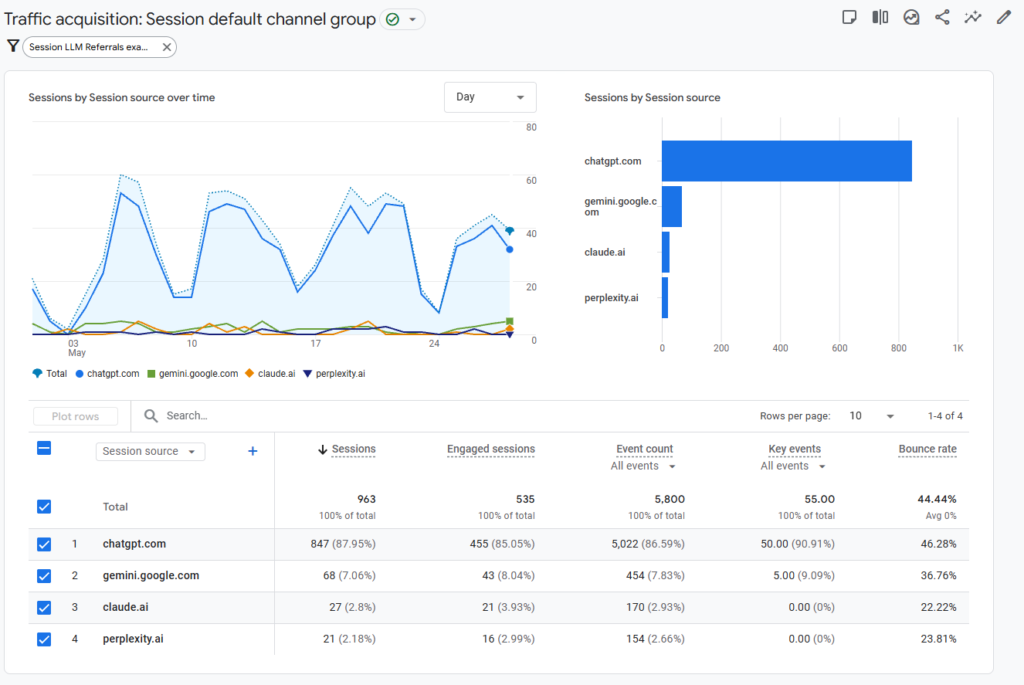
LLM platforms show up as referral sources in GA4. Here’s how to find them:
- ChatGPT:
chatgpt.com - Perplexity:
perplexity.ai - Claude:
claude.ai - Google AI Overviews: appears within
google.com / organic– harder to isolate but growing
Create a GA4 segment filtering for these referral sources and track sessions, engaged sessions, and conversions separately from Google organic. The conversion rate difference alone makes this worth tracking – in one B2B software case study, ChatGPT referrals converted at 15.9% vs. Google organic’s 1.76%. (Seer Interactive)
Manual Citation Auditing
The simplest measurement process: query your target topics in ChatGPT, Perplexity, and Google AI Overviews. Note whether your site is cited, how you’re described, and whether the description is accurate.
Run this monthly for your three to five primary topic queries. Inaccurate descriptions – being misrepresented as a tool vendor when you’re a consultant, for example – are worth correcting. They directly affect how the LLM represents your brand to users actively researching a purchase or hire.
This manual audit takes thirty minutes per month and reveals more than most tracking tools currently can.
LLM SEO Tools Worth Using
The LLM SEO tools market is early and moving fast. A full evaluation is coming in a dedicated post. For now, three worth knowing:
- Profound: Tracks brand mentions and citations across AI platforms. Best-in-class for citation monitoring.
- Brand24 / Mention: Broader listening tools that capture LLM-origin discussions and brand mentions across the web.
- Ahrefs: Not an LLM tool, but organic keyword tracking for the traditional SEO signals that directly feed RAG systems. If you rank on Google, you’re more likely to be cited by LLMs that pull from Bing.
Conclusion
Next Steps
- Audit your Bing Webmaster Tools setup and submit your sitemap if you haven’t already.
- Add BlogPosting and FAQPage schema to your top ten posts. A WordPress mu-plugin handles this site-wide automatically.
- Create an llms.txt file and place it at your domain root.
- Set up a GA4 segment for ChatGPT, Perplexity, and Claude referral sources.
- Run a manual citation audit: query your three primary topics in ChatGPT and Perplexity today.
Sources
LLM SEO Implementation Checklist
- Add BlogPosting schema to every blog post so LLMs read content type, author, and dates from structured data.
- Add FAQPage schema to any post with a Q&A section.
- Create an llms.txt file at your domain root giving LLMs a structured overview of your site.
- Verify Bing Webmaster Tools and submit your sitemap, since ChatGPT’s search runs on Bing.
- Check page load speed, because slow pages time out LLM crawlers like Perplexity’s.
- Keep content fresh by updating dateModified through genuine updates or a systematic review process.
- Write with specificity: named examples, practitioner detail, and original data, so each section can stand alone and answer a question.
- Build off-site authority over time through consistent topical publishing, guest bylines and industry mentions, and an active LinkedIn profile.
Frequently Asked Questions
What is LLM in SEO?
LLM stands for large language model – the AI systems behind ChatGPT, Claude, Gemini, and Perplexity. LLM SEO is the practice of optimizing your content to be retrieved and cited by these models in their generated responses, rather than simply ranking in traditional search results.
What is the difference between traditional SEO and LLM SEO?
Traditional SEO targets search engine algorithms to earn rankings on result pages. LLM SEO targets retrieval systems inside AI tools to earn citations in AI-generated answers. The core quality signals overlap heavily – structured content, authoritative sources, topical depth – but freshness requirements are stricter and brand mentions carry more weight in LLM SEO.
Is SEO dead or evolving in 2026?
Evolving, not dead. Traditional search still drives the majority of web traffic, and the fundamentals of ranking – quality content, backlinks, technical health – haven’t changed. What’s changed is that AI-generated answers now intercept a growing share of informational queries, so a complete search strategy in 2026 requires optimizing for both traditional rankings and LLM citation.
How do LLMs find and use my website’s content?
Through two pathways: training data (content indexed and embedded during model training) and live RAG retrieval (real-time web search that supplements responses with current content). You have limited control over training data but direct control over RAG eligibility through indexability, freshness, structured markup, and Bing presence.
What are the most important LLM SEO best practices?
In priority order: get indexed by Bing, add BlogPosting and FAQPage schema markup, keep content fresh with regular updates, write structured content with clear headings and standalone-answerable paragraphs, build off-site brand mentions through LinkedIn and guest bylines, and track LLM referral traffic in GA4.