Most marketing leaders are approaching AI the same way they approach new software: plug it in, leave the org intact, and call it a transformation. New tools. Same boxes on the org chart. Same handoffs, same status meetings, same coordination overhead.
That’s the wrong model.
If you bolt AI onto an existing team structure, you get marginal efficiency gains. The structure itself is the problem. Marketing org charts were designed to coordinate people. That’s their entire purpose — to route work through humans in a predictable sequence. When agents can handle most of that routing, the structure no longer makes sense.
What you need instead is a system that produces output and gets smarter over time. That’s a different shape than a hierarchy.
Key Takeaways
- The traditional marketing org chart is built to coordinate people, not produce output.
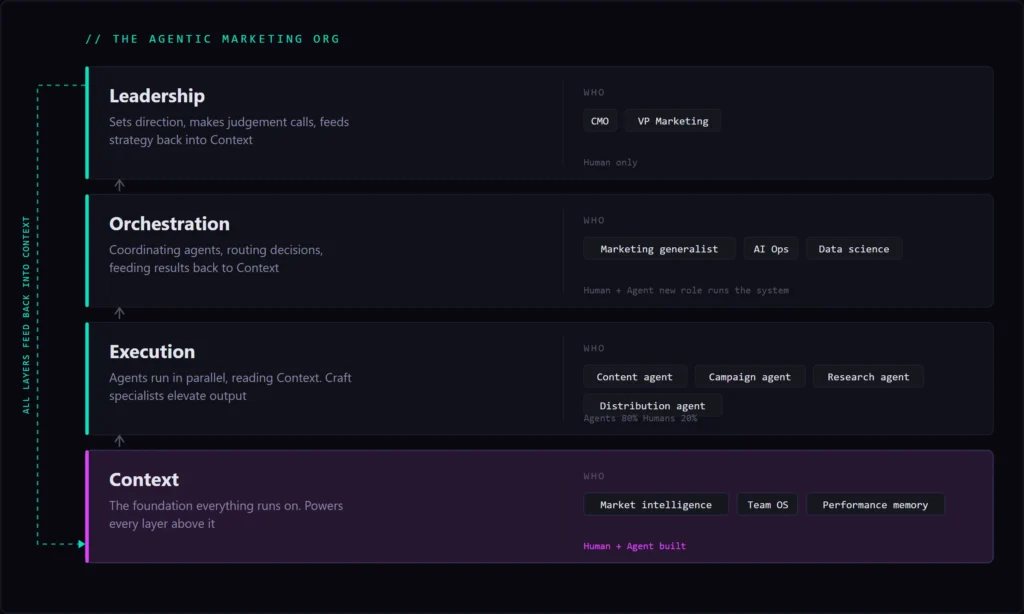
- Rebuilding for the agentic age means adopting a four-layer model (Context, Execution, Orchestration, Leadership) in which each layer reads from the one below it and writes its learnings back to it.
- The biggest unlock is Layer 1: a shared intelligence layer that survives employee turnover.
- Agents handle volume; humans own the brief, the bar, and the judgment calls.
- The orchestration role is new and critical. Leadership stops coordinating and starts steering a system.
What this model is actually about
Let me address the obvious fear: this isn’t about replacing marketers with agents.
AI should eliminate the coordination tax — the status updates, the handoffs, the “just circling back” Slack messages — and concentrate human attention where it creates actual value. The humans don’t disappear. They stop coordinating and start directing. Fewer people managing other people. More marketers running systems, exercising judgment, doing the craft work that agents can’t fake.
There are four layers to the model. The critical detail: every layer reads from the one below it, and every layer writes its outputs back to it. It’s a loop, not a ladder. The system is designed to get smarter every time it runs.
Layer 1: Context — the foundation everything runs on
This is the biggest leverage point available to marketing teams right now, and almost nobody has built it properly.
Before AI, your institutional intelligence lived in people’s heads. What the market actually cares about. How a campaign really gets shipped at your company. Which plays worked and which quietly died. When someone left, that knowledge left with them.
Context is the system that captures this intelligence — market knowledge, how the team operates, what’s working, what isn’t — and makes it readable by every human and every agent above it. It updates automatically from the work you do. Everything else reads from this layer and writes back to it. Get it right, and every layer above gets smarter. Get it wrong, and you’ve automated confusion at scale.
A few things that aren’t obvious about building this layer:
This is infrastructure, not a wiki tidy-up. It’s real data engineering: CRM, analytics, support tickets, call transcripts, brand guidelines, campaign history, stitched into something queryable. Most teams budget for a Notion cleanup and wonder why it fails. The honest framing is that this is infrastructure, and infrastructure has a cost and a maintenance burden.
Someone has to own it. “The team” will let it go stale. There has to be a named owner — most likely AI Ops or RevOps — with senior strategists curating what’s actually true. This is a new marketing discipline, not a role you bolt onto someone’s existing job.
It has to be deterministic. If the same question returns different answers on different days, you don’t have an intelligence layer. You have a slot machine. That requires declared definitions before you store knowledge. “Campaign” means five different things across most companies. The vocabulary has to be fixed before the learning begins.
Start lean. Three to five trusted, high-quality artifacts beat a giant pile of low-signal content. Someone with taste has to decide what gets ingested and what stays out. A context layer that feeds on its own bad outputs slowly poisons itself.
The mature version isn’t marketing-only. Customer knowledge lives in sales and CS. Product owns the roadmap. Finance owns the unit economics. If Context is a marketing silo, it’s already missing most of the company’s intelligence. The refined model: Context is an enterprise asset that marketing reads from and contributes to — not something marketing builds in a corner.
Layer 2: Execution — agents at volume, humans at the bar
This is where the work gets made. It’s a combination of agents running in parallel and a smaller number of genuine craftspeople.
Why “craftspeople” instead of just “marketers”? Because when everyone has access to the same models, good enough becomes the floor — not the ceiling. AI can draft most of a thing. The gap between forgettable and unmissable lies in taste, judgment, and the customer’s real knowledge. That gap is widening as more undifferentiated AI content floods every channel.
A few things worth naming clearly:
Humans set the brief and hold the bar — they don’t just review the output. The temptation is to have agents draft something, and humans edit it at the end. That’s the wrong sequence. Human judgment belongs at the beginning: the angle, the brief, the standard. Then, agents do the volume work in the middle. Then humans exercise discernment at the end. It’s a different model than “agent first, human last.”
Some marketing work doesn’t compress at all. A whole category of marketing isn’t an output an agent can draft — it’s a relationship. Distribution through events, partnerships, community, influencer, and founder brand. Physical activations. The room. These were never digitally instrumented, so they never enter an automated feedback loop. The model has to respect this and leave that work to humans, rather than pretend that an agent will eventually absorb it.
The right mental model for Layer 2: agents handle volume; humans determine prompts, set guardrails, and own the quality bar. Not a 20% final polish. A starting standard that agents execute toward.
Layer 3: Orchestration — the role that matters most right now
Your org isn’t a tree anymore. It’s a system producing output. Someone has to run that system: make routing decisions, monitor what agents produce, verify they’re reading the right context, and feed the results back into Layer 1.
This is the newest role in marketing and, in my view, the most important one to get right over the next two years.
It’s probably two roles, not one. There’s an Orchestrator who designs the system — decides what flows where, which decisions stay human, which get agent-drafted for human approval, which run fully autonomously. And there’s an Operator who lives in the system daily, QAs the agents, and improves them. Design versus run. Most teams will need both, even if one person wears both hats at first.
The hard part isn’t routing tasks. It’s the delegation logic. What’s allowed to run autonomously? What gets escalated? What never leaves a human’s hands? These are deliberate design choices, not defaults. They belong in this layer and must be revisited as the system evolves.
Who actually fills this role? From what I’m seeing, it’s one of three people: a RevOps lead, a GTM product manager who came up through Marketing Ops, or an AI generalist who built something in the previous layer and got promoted for it.
Layer 4: Leadership — direction, not coordination
The new leadership job is to set direction for a system, refine it, and get output from it. Not coordinate people. Not manage the org chart. Steer the engine, make the judgment calls it can’t make on its own, and feed strategy back into Context so the whole system inherits your point of view.
A few things worth being direct about:
Not every current CMO is equipped for this. One data point: only 15% of CEOs consider their CMO AI-savvy, according to a Gartner survey of 456 executives. (Gartner) Most marketing leaders were selected because they’re good at coordinating people and managing complex org charts. This model asks them to direct systems instead. That’s a genuinely different skill. For some, it’s learnable. For others, it’s a hiring reset. If the leader can’t see that the rebuild is necessary, the rebuild still happens — but it happens to the team, not with it.
Why is Leadership the human-only layer? Not because leaders shouldn’t use agents — they absolutely should, including for strategy. It’s human-only because someone has to own the taste the system optimizes toward, and carry accountability for the judgment calls when the model is confidently wrong. You can automate the work. You can’t automate accountability for it.
Two fair objections
“Is this actually new, or just a good marketing process with better tools?”
Partially fair. A lot of what this model demands — clear thinking, real craft, tight feedback loops — is what great marketing has always required. What’s genuinely new is the substrate. A shared intelligence layer that survives employee turnover was not possible before. The roles change because the unit of work shifts from “a person does a task” to “a person directs a system that does the tasks.” Today, the most intelligent marketer on your team makes themselves smarter by working. In this system, they make the entire team smarter.
“Where do junior marketers learn the craft if you compress the middle?”
This is the most honest gap in the model. If you remove the entry-level rungs people used to climb — the execution work where judgment gets built slowly through repetition — you risk a generation that can operate agents but can’t distinguish good from great. My working view: the entry path shifts from “do the task” to “operate the system and build the context layer.” AI fluency has to come before you redesign the org, not after. Anyone who tells you this is fully solved is guessing. It’s one of the harder problems this transition creates.
The shape of the work ahead
The teams that get this right won’t be the ones that bought the most AI tools. They’ll be the ones who built the Context layer first, hired for craft and judgment instead of task throughput, and found someone who could design the system and keep it running.
Most of that work is unglamorous. It’s infrastructure. Its definition works. It’s taste decisions about what goes into the intelligence layer and what stays out. None of it shows up in a demo.
But it’s what separates a marketing team that compounds from one that just runs faster on the same treadmill.
FAQs
What is an agentic marketing team?
An agentic marketing team is structured around AI agents handling high-volume, repeatable work — drafting, research, campaign execution — while humans concentrate on the brief, the standard, and the judgment calls that agents can’t make reliably. It’s organized as a four-layer system (Context, Execution, Orchestration, Leadership) rather than a traditional functional hierarchy.
Does rebuilding for AI mean replacing marketers?
No. The goal is to eliminate the coordination overhead — status meetings, handoffs, administrative work — and redirect human attention to where it adds the most value: creative judgment, customer understanding, strategy, and craft. The headcount that disappears is coordination headcount, not craft headcount.
What is the Context layer, and why does it matter?
The Context layer is a shared intelligence system that captures market knowledge, team operating knowledge, and performance memory — and makes it readable by every human and agent in the org. It matters because, without it, institutional knowledge lives in people’s heads and leaves when they do. With it, every agent and every new hire inherits the team’s accumulated learning from day one.
Who should own the Orchestration layer?
In most organizations, the orchestration role is filled by a RevOps lead, a GTM product manager with a Marketing Ops background, or an AI generalist who built systems at the execution layer. It typically splits into two functions: an Orchestrator who designs the system and sets delegation logic, and an Operator who runs it day-to-day and improves the agents.
Is every current CMO equipped to lead an agentic marketing org?
Not necessarily. Gartner data shows that only 15% of CEOs consider their CMO AI-savvy. Most marketing leaders were selected for their ability to coordinate people and manage org charts — a different skill set than directing systems. Some will adapt; for others, this represents a hiring reset at the leadership level.