Everyone is frantically adding AI to their GTM. Very few are running a true agentic-first motion. That gap, between integrating AI and reorienting your entire go-to-market around it, is where the next competitive divide is forming.
This is not a new pattern.
When factories first gained access to electricity in the late 1800s, most didn’t redesign their operations. They replaced the steam engine with an electric motor and kept everything else the same: the layout, the workflows, the staffing model. Productivity barely moved. For decades, economists couldn’t find electricity’s impact in the output data, what they called the productivity paradox.
The factories that eventually transformed weren’t the ones that got electricity first. They were the ones who rebuilt the floor around it. New layouts. New workflows. New roles. Once that happened, productivity compounded.
Key insight
Most companies are currently replacing steam engines with electric motors. A few are rebuilding the floor.
Key Takeaways
- Agentic-Led Growth (ALG) is the next primary B2B growth model after Sales-Led and Product-Led Growth.
- In ALG, intelligence lives in a shared context layer that compounds with every agent interaction, rather than in individual reps or the product alone.
- Three agent modes coexist: fully autonomous, agent-primary/human-closing, and agent-amplified human judgment.
- The infrastructure runs on three layers: Context (shared intelligence), Action (agents doing work), and Coordination (human-agent collaboration).
- The companies winning build the Context Layer first.
- Clean data is the prerequisite.
- Measure improvement slope, not launch-day performance.
What Agentic-Led Growth Actually Is
Every era of B2B growth has had a primary motion.
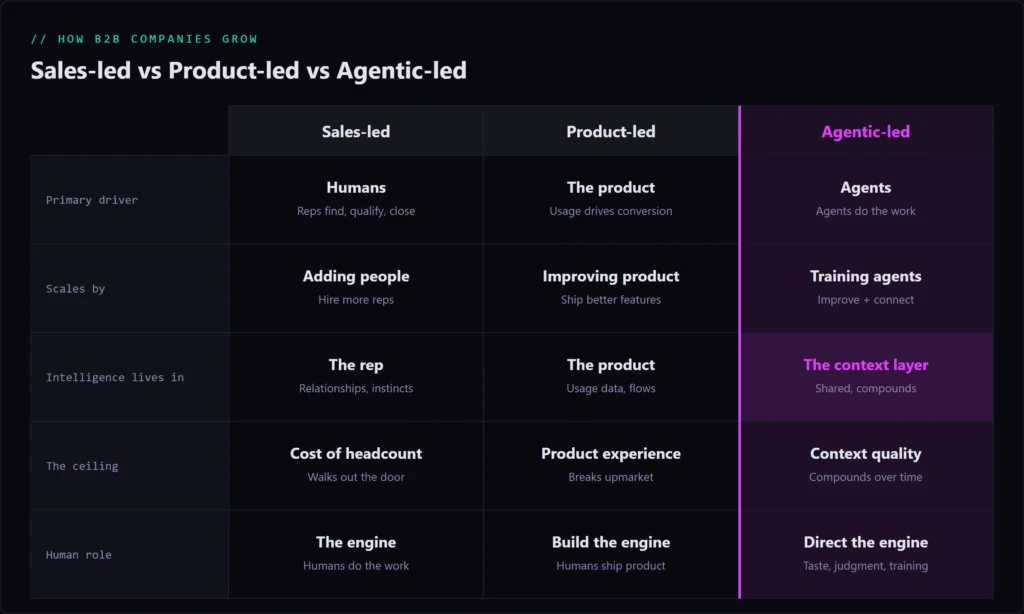
In sales-led growth, humans did the work. Reps found, qualified, and closed. The system was scaled by adding people. In product-led growth, the product did the work. Usage, activation, and viral loops drove acquisition and expansion. The system was scaled by improving the product.
Both models followed the same underlying logic: identify the most powerful driver of revenue and build your entire GTM motion around it.
But there’s a second thread running through these models that gets less attention. Each one also represents a different answer to the question of where intelligence lives.
In sales-led growth, intelligence lives in the rep. Relationships, instincts, playbooks, and pattern recognition built over years of selling. It’s powerful, and it’s deeply human. It’s also expensive to hire, hard to scale, and walks out the door when the rep does.
In product-led growth, intelligence moves into the product. Usage data, activation flows, growth loops. It compounds as more users move through the system and scales without adding headcount. But PLG has a natural boundary: it works when the product experience itself is enough to drive the next step. The moment your growth depends on customers who need more than the product can give them (a commercial conversation, a tailored onboarding, a relationship that exists outside the app), the model runs out of road. That’s why every PLG company that moves upmarket eventually builds a sales motion on top.
In Agentic-Led Growth, intelligence lives in the context layer. Shared across every agent, every stage, every customer interaction. It doesn’t leave when a rep does. It doesn’t plateau when the product reaches its activation limits. It compounds with every interaction the system handles.
| Growth Model | Where Intelligence Lives | How It Scales | Where It Breaks Down |
|---|---|---|---|
| Sales-Led | In the rep | Add headcount | Expensive, doesn’t survive turnover |
| Product-Led | In the product | Improve activation loops | Hits a ceiling when humans are required |
| Agentic-Led | In the context layer | Compounds with every interaction | Requires clean data and shared context infrastructure |
Each model in that sequence is not an improvement on the one before it. It’s a different answer to the same question: what is the primary driver of revenue, and how do you build your entire GTM motion around it? Sales-led companies didn’t become product-led by adding a free trial. They rebuilt the motion. Product-led companies won’t become agentic-led by deploying a few agents. The same rebuild is required.
Agentic-Led Growth is a GTM model where AI agents own the repeatable, context-driven work across every stage of the customer lifecycle: acquiring demand, engaging it, monetizing it, and delighting customers once they buy. Agents do this autonomously where the task allows, and in collaboration with humans where taste and judgment are required.
Humans contribute three things the system fundamentally depends on: taste, to set the standard agents execute to; judgment, to make the calls no amount of data can fully determine; and continuous agent training, to make the system smarter over time. In a copilot model, a good rep makes themselves more productive. In an Agentic-Led GTM, a good rep makes the entire system smarter.
Three Modes That Coexist in a Mature Agentic GTM
Fully autonomous. The task is well-defined, the right answer is derivable from context and data, and human taste and judgment add no meaningful value at the point of execution. The agent owns it entirely. The human’s role was upstream: setting the standards, training the agent, defining what good looks like. In practice: an inbound qualification agent that handles competitive questions and books meetings with no human in the loop; an AEO agent that ensures your brand appears in AI-generated answers before a buyer ever enters the funnel.
Agent-primary, human-closing. The agent owns everything up to the moment where taste or judgment becomes the deciding factor. The human doesn’t do the groundwork. They arrive at the moment that matters (the sales call, the escalation, the strategic conversation) with more context than they’ve ever had, having spent none of their time getting there. In practice: a prospecting agent that identifies intent signals, builds the personalized sequence, times the outreach, and creates the task at precisely the right moment. The rep’s energy goes entirely into the conversation that follows.
Agent-amplified human judgment. The task requires human judgment throughout, but agents continuously surface better context, signals, and timing, making judgment sharper and better informed at every step. The human still owns the outcome. The agent makes them better at delivering it.
The consistent thread across all three is that agents handle the work that doesn’t require a human, so humans can focus entirely on the work that does. And every time a human exercises taste or judgment within the system, whether refining an agent-drafted sequence, overriding a recommendation, or rewriting a brief, that signal feeds back into the system and makes it better. That is the rebuilt factory floor. That is why it compounds.
What This Looks Like Across the Customer Journey
Acquire: Finding the Right Demand Before Your Competitors Do
A demand agent identifies ICP-match companies, enriches contacts from multiple data sources, and generates a prospect value score that predicts both the likelihood to close and the expected ARR.
The lesson most teams miss: agents are only as good as the data they run on. Before results compound, you have to invest heavily in data quality: enriching contacts, removing defunct records, and building golden record standards across the CRM. It’s unglamorous work that takes longer than anyone wants. It’s also the work that makes everything else possible. If your CRM is messy, your agents will be confidently wrong at scale. Clean data is not a nice-to-have prerequisite. It is the foundation.
AEO (Answer Engine Optimization) is the acquisition channel that most teams are still underestimating. It’s the practice of making your brand visible and credible in AI-generated responses from tools like ChatGPT and Google AI Mode. A meaningful and growing percentage of your buyers are now asking AI tools for software recommendations instead of Googling. If you are not visible in those responses, you do not exist for that buyer. It is a channel that is already growing faster than anything else in most acquisition mixes.
Engage: Converting Demand With the Right Combination of Agents and Humans
An inbound qualification agent handles competitive questions, uses propensity scoring to identify buying intent, and books meetings directly with sales reps. The metric that matters here isn’t launch-day performance; it’s the slope of improvement. An agent that improves two to three points per month for a year becomes something fundamentally different from what it was at launch. The teams shut agents down after 30 days because the early numbers missed the curve entirely.
One finding that consistently surprises teams: rewriting the agent’s instructions to handle one task at a time yields a larger performance gain than upgrading to a more powerful AI model. Better prompts beat better models. That’s not what most teams expect when they start optimizing.
A prospecting agent orchestrates outreach across all channels, tracking intent signals, generating personalised multi-touch sequences, creating tasks for reps at the right moment. The original assumption most teams make is that AI-personalized email sequences will do most of the work. They don’t. What actually works is the combination: automated outreach coupled with a human conversation drives significantly higher meeting conversion than either channel alone. Agents are best at removing latency from the process. Humans are best at what follows.
Monetize: Closing and Expanding Revenue With Better-Informed Humans
This is the clearest example of agent-amplified human judgment. AI does not run the deal. It surfaces the right plays, the right content, the right risk signals at the right moment, so the rep’s instincts are sharper and better timed. The rep still owns the relationship. The rep still makes the call. The agent makes them better at both.
The distinction that matters when designing what your agents do at this stage: a rep using AI agents is not faster at doing the same job. They are better at doing a harder one.
The Invisible Layer That Makes It Work
There’s more to agentic-led growth than the agents. You have to think about your AI infrastructure in three layers.
Context Layer. Where customer understanding lives. Not just structured CRM data, but unstructured data: call transcripts, email threads, support conversations, usage patterns, sales stage history. This is the foundation. Context needs to flow across agents: what the demand agent knows should inform the prospecting agent; what the prospecting agent learns should reach the sales agent; what the support agent resolves should be available to customer success.
Action Layer. Where work gets done. Your agents, automations, and assistants. These are only as good as the context they have access to. An agent with a rich context layer operates with years of account history for every interaction. An agent without it is starting from scratch every time.
Coordination Layer. Where humans and agents collaborate. Governance. Routing rules. Handoff protocols. Feedback loops. This is where adoption either happens or doesn’t. Naming matters, workflow integration matters, and team understanding of what the agent is doing and why matters. The best-designed agent fails if the team does not trust it or cannot see what it is doing.
Most companies start with the Action Layer. Build an agent. Deploy it. Measure it. That’s the rational starting point, and there’s nothing wrong with it.
The companies that sustained results built the Context Layer first or in parallel. Not the agents themselves, but the infrastructure the agents run on. Agents in silos plateau. Agents with shared context compound.
The Objection Worth Addressing
“This is enterprise-scale infrastructure. We don’t have those resources.”
Fair. Here’s the direct version of what the sequencing looks like at any scale:
- Start with support. The feedback loops are tightest, the ROI is clearest, and organisational confidence in AI compounds from there. A support agent resolving a meaningful percentage of tickets without human involvement is a legible win that earns credibility to go further.
- Invest in data quality before agents. Every team seeing the highest returns from agents made this investment first.
- Measure the slope, not the launch. Every agent in an effective system started with modest results. The teams that kept improving them quarter over quarter are the ones now running at high automation rates.
- Orchestrate across channels, not within one. Email alone does not work. Calls alone do not work. Agents handling timing and personalisation combined with humans handling the conversation: that’s what works.
- Build the Context Layer first. Or at least in parallel. The compounding comes from shared intelligence. Without it, you are running features, not a system.
- Treat adoption as a product problem. The best-designed agent fails if the team does not trust it or cannot see what it is doing.
The Pattern Recognition Question
In 2013, Blake Bartlett at OpenView Partners was watching a handful of SaaS companies behave strangely. Datadog. Expensify. A few others. They were growing fast, with almost no outbound sales motion. By every rule of the VC playbook, they should have been struggling.
What Bartlett eventually understood was that the product itself was doing the selling, not passively but structurally. These companies had removed so much friction from time-to-value that users became the primary acquisition channel. The sales funnel had not disappeared. It had inverted.
He didn’t formally coin the term “Product-Led Growth” until 2016. (OpenView) By then, Slack had grown to a multi-billion-dollar valuation with almost no traditional sales organization. (TechCrunch) Dropbox had proven that consumer-grade UX could drive B2B adoption at scale.
The term gave coherent language to something that had been happening for three years without a name. And once it had a name, every serious GTM leader had to have a position on it.
The pattern for Agentic-Led Growth is the same. The companies building it are seeing documented, public results. The naming moment is happening now.
The question is the same one it was with PLG: are you in the early-adoption cohort that builds the infrastructure before the playbook is obvious, or the second-wave cohort that adopts once it’s proven?
Neither answer is wrong. The second-wave cohort with PLG still won. But the companies that understood what Bartlett was pointing at in 2013 had a three-year head start on the compounding.
The factories that replaced steam engines with electric motors eventually caught up too. But the ones that rebuilt the floor first? They compounded while everyone else was still figuring out the wiring.
FAQs
What is Agentic-Led Growth?
Agentic-Led Growth (ALG) is a go-to-market model where AI agents own the repeatable, context-driven work across every stage of the customer lifecycle: acquisition, engagement, monetization, and retention. Agents operate autonomously when tasks are well-defined, and in collaboration with humans when judgment and taste are required. Intelligence lives in a shared context layer that compounds with every interaction, rather than in individual reps or the product.
How is Agentic-Led Growth different from just using AI tools?
Using AI tools means adding AI capabilities to an existing GTM structure. Agentic-Led Growth means rebuilding the GTM motion to make AI the primary driver. It is the same distinction that separated PLG from companies that simply added a free trial: a structural change, not a feature addition. The difference in outcomes compounds over time.
What is the Context Layer and why does it matter?
The Context Layer is the shared intelligence infrastructure that every agent in the system reads from and writes to. It includes structured CRM data plus unstructured data: call transcripts, email threads, support conversations, usage patterns, and sales history. Without a shared Context Layer, agents operate in silos and plateau. With one, they compound, each interaction making the next one smarter.
Where should a company start with Agentic-Led Growth?
Start with support; the feedback loops are tightest, and the ROI is clearest. Invest in data quality before investing in agents. Build the Context Layer in parallel with your first agent deployments rather than after. Measure the slope of improvement, not launch-day performance. And treat adoption as a product problem: the best agent fails if the team doesn’t trust it.
Does Agentic-Led Growth eliminate the need for sales reps?
No. It changes what reps do, not whether reps exist. In an ALG model, agents handle the groundwork, prospecting, qualification, timing, and personalization, and reps arrive at the moment that actually requires human judgment with more context than they’ve ever had. The best reps in an ALG system don’t just make themselves more productive; they make the entire system smarter by feeding their judgment back into it.
What is AEO, and how does it fit into Agentic-Led Growth?
AEO (Answer Engine Optimization) is the practice of making your brand visible and credible in AI-generated responses from tools like ChatGPT and Google AI Mode. It fits into the Acquire stage of ALG as a fully autonomous agent capability. As more buyers use AI tools for software research instead of search engines, AEO is becoming a primary acquisition channel. If your brand doesn’t appear in those AI-generated answers, you don’t exist for that buyer.