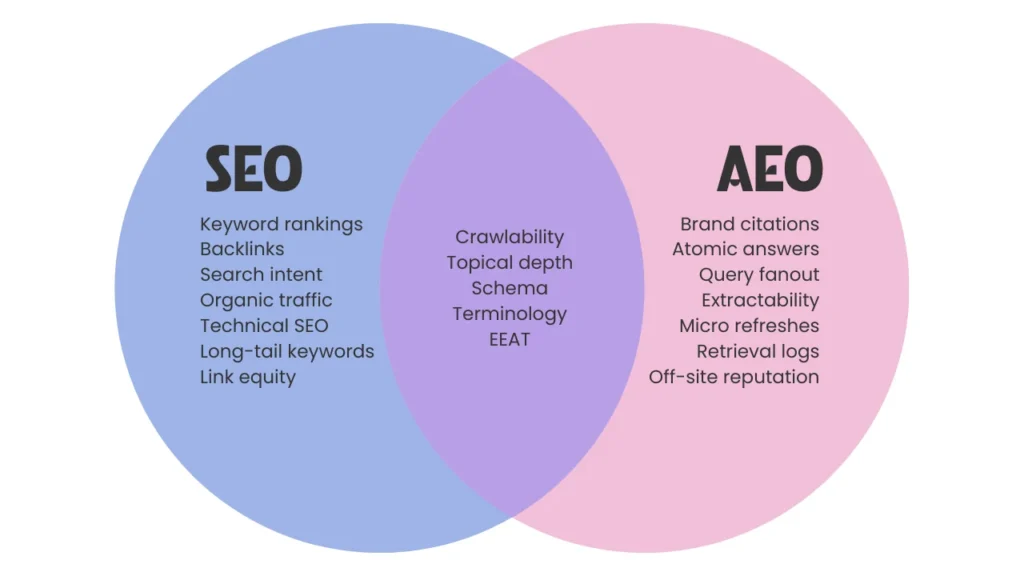
A growing share of your buyers no longer start at Google. They ask ChatGPT, Perplexity, or Google’s AI Mode, and they act on the synthesized answer without clicking a single link. For B2B SaaS marketers, that splits one job into two: rank in traditional search, and get cited in AI answers. SEO covers the first; AEO covers the second.
This is a practitioner’s breakdown of how the two differ, where they overlap, and how to run both without doing double the work.
Key Takeaways
- SEO optimizes for rankings and clicks in traditional search; AEO (Answer Engine Optimization) optimizes for being cited inside AI-generated answers from ChatGPT, Perplexity, and Google’s AI Overviews.
- They share a foundation: clean technical infrastructure, genuine topical authority, credible sourcing, and schema. You don’t rebuild from scratch for AEO.
- AEO adds specific demands: atomic, extractable answers; an editorial point of view; monthly freshness; and off-site validation across sources AI systems trust.
- AEO complements SEO, it doesn’t replace it. B2B SaaS teams need both, and the practical path is to start from strong SEO fundamentals and layer AEO on top.
What Is the Difference Between SEO and AEO?
SEO earns rankings in traditional search results and drives clicks to your site. AEO earns citations inside AI-generated answers, where the user often never clicks at all. Traditional SEO continues to generate sustainable organic traffic through Google rankings, while AI-powered answer engines increasingly intercept informational queries before they ever reach a website.
The bottom line
Modern content strategy requires both. SEO for direct website traffic, AEO for presence in the AI-powered answers your buyers now read first. “Ranking” has quietly expanded to include being featured, cited, or recommended inside an AI response.
Understanding SEO: Traditional Search Engine Optimization
Search engine optimization is the practice of optimizing content to rank higher in traditional search engine results pages. The goal is qualified organic traffic, earned through improved visibility in Google’s standard blue-link listings.
For B2B SaaS, traditional SEO focuses on:
- Keyword targeting: optimizing pages for the terms your buyers actually search.
- SERP positioning: competing for top placements on the results page.
- Click-through rate: earning the click once you rank.
- Conversion: turning organic visitors into qualified leads.
Understanding AEO: Answer Engine Optimization
Answer engine optimization prepares content for AI systems that generate a direct response rather than a list of links. These systems pull from multiple sources to assemble one answer, so the goal shifts from ranking a page to being one of the sources that answer is built from. For the full playbook, see my AEO content strategy framework.
AEO optimization targets:
- Content extraction: making information easy for an AI system to lift cleanly.
- Citation inclusion: getting named inside the generated answer.
- Brand attribution: ensuring you get credited when your content is synthesized.
- Conversational follow-ups: holding up across multi-turn questions, not just the first query.
SEO vs AEO: A Side-by-Side Comparison
| Aspect | SEO | AEO |
|---|---|---|
| Primary goal | Higher rankings in traditional SERPs to drive site traffic | Get cited and featured in AI-generated answers |
| User journey | Users click through to sites for detail | AI delivers a direct answer, often with no click |
| Content structure | Keyword-optimized content with internal linking | Atomic answers that stand alone when extracted |
| Success metrics | Rankings, organic traffic, CTR, conversions | Citations in AI responses, brand mentions, extraction accuracy |
| Update frequency | Quarterly or annual refreshes | Monthly updates with fresh data and timestamps |
| Discovery method | Users search, scan results, click | AI extracts and synthesizes across multiple sources |
| Content format | Long-form with strategic keyword placement | FAQs, definition blocks, comparison tables |
| Trust signals | Backlinks, domain authority | Multi-source validation, structured credibility |
| Keyword strategy | Short-tail, exact-match, informational | Natural-language, question-based, conversational |
| Traffic pattern | Direct site visits and sessions | Indirect brand exposure through citations |
Key Differences: SEO vs AEO
Discovery and traffic patterns
In SEO, users enter a query, scan the results, and click through to a site for detail. In AEO, the AI system analyzes the question, extracts relevant information from multiple sources, and presents a synthesized answer directly, often ending the journey before any click.
Content structure requirements
SEO content flows as a narrative with keyword integration and internal linking. AEO content has to work in fragments: atomic answers that stay accurate and complete even when an AI lifts them out of their original context.
Performance measurement
The two are measured on different scoreboards.
- SEO: rankings for target keywords, organic traffic volume, click-through rate, lead and conversion rates.
- AEO: citations in AI responses, brand mentions across answer engines, accuracy of the extracted information, and indirect traffic attribution.
Content maintenance
SEO content can hold its rankings on a quarterly or annual refresh. AEO rewards recency more aggressively: monthly updates with fresh data, recent examples, and current timestamps measurably improve the odds of being selected.
What SEO and AEO Share
The overlap is larger than the hype suggests. Both run on the same foundations, which is why you layer AEO onto good SEO rather than starting over.
| Shared requirement | How both SEO and AEO benefit |
|---|---|
| Technical infrastructure | Clean URLs, fast load times, crawlable pages, and proper sitemaps serve both search crawlers and AI systems. |
| Content quality | Authoritative, expert content builds trust with Google’s algorithms and AI confidence scoring alike. |
| Trust signals | Named authors, credible sources, and recent data validate content for both rankings and citations. |
| Information architecture | Clear site structure helps crawlers and AI systems map relationships and context. |
| Schema markup | Structured data feeds both Google’s knowledge graph and AI systems. |
| Mobile optimization | Mobile-friendly design is required by traditional algorithms and AI search experiences. |
Topical authority matters even more for AEO than for SEO: AI systems favor sources that cover a subject comprehensively, and domains that treat a topic from multiple angles earn repeated citations while isolated one-off pages rarely surface at all.
AEO-Specific Optimization Requirements
Create extractable content structure
AI systems work with fragments, which calls for structure traditional SEO writing doesn’t require:
- Atomic answers: open each section with a direct sentence that mirrors the heading and fully answers it, even when read in isolation.
- Intent constellations: build hub pages that address a primary question alongside its related sub-questions, so you hold up across conversational follow-ups.
- Machine-readable formatting: FAQ blocks, definition blocks, comparison tables, numbered steps, and bulleted feature sets.
Maintain freshness
AI systems weight current information more heavily than traditional algorithms do. Run monthly refreshes on your most strategic pages with updated statistics and visible timestamps, and keep critical data points no older than about three years. Recency reads as reliability to AI confidence scoring.
Build external validation
AI systems corroborate claims across multiple sources before including them in an answer. That makes off-site presence an AEO lever, not just an SEO one:
- Contribute expertise to industry forums and discussions.
- Keep current profiles on relevant directories and review platforms.
- Earn mentions in expert roundups, research, and on platforms like Reddit and G2 that AI systems commonly draw from.
How to Implement SEO and AEO Together
Audit and find the gaps
Run your core buyer queries through ChatGPT, Perplexity, and Google’s AI Overviews. Document where competitors are cited and you aren’t. Then prioritize the queries tied to your product category, core features, and competitive advantages, because citations on those topics influence purchase decisions directly.
Develop the content
Build hub pages that answer one primary question plus eight to twelve related sub-questions; this hub-and-spoke shape outperforms single-focus pages in conversational search. Then put your highest-value pages on a refresh schedule rather than publishing and walking away.
Monitor performance
Track AI citations manually for your key queries: frequency, accuracy, and competitor presence. Keep monitoring your traditional SEO baseline in parallel, because AEO work should enhance traditional performance, never compromise it.
The Future of Search: Preparing for Both
AI-powered search doesn’t retire traditional SEO. It adds a second surface to optimize for. The B2B SaaS teams that win are the ones visible in both places, regardless of how a given buyer chooses to search. Start from strong SEO fundamentals, then layer on AEO: structured answers, regular updates, and external validation. Ignore the AEO layer and you cede that ground to competitors who didn’t.
Frequently Asked Questions
What is the difference between SEO and AEO?
SEO optimizes for rankings and clicks in traditional search results. AEO (Answer Engine Optimization) optimizes for being cited inside AI-generated answers from tools like ChatGPT, Perplexity, and Google’s AI Overviews. SEO focuses on traffic generation; AEO focuses on getting your content extracted and credited by answer engines.
What is AEO and how does it work?
AEO is the practice of structuring content so AI answer engines can easily extract and cite it. The systems scan multiple sources, identify credible answers, and synthesize a response that references your content, increasing brand visibility even without a direct website visit. In marketing terms, it’s how you stay visible as buyers shift from searching to asking.
What is an example of AEO?
Ask an AI tool “what’s the best way to structure a blog post for SEO?” and the answer that appears, assembled from sources the model trusts and sometimes citing them by name, is AEO at work. The pages that get pulled into that answer are the ones optimized for extraction: direct, well-structured, and credibly sourced.
How do I optimize for AEO?
Write atomic answers that make sense when extracted, use FAQ and definition formats, add schema markup, keep timestamps fresh, and target conversational, question-based queries. Build topical authority across related sub-questions rather than isolated pages, and earn external validation on sources AI systems trust.
Will AEO replace SEO?
No. AEO complements SEO rather than replacing it. Traditional search still drives significant traffic and conversions, while AEO captures the informational queries now answered by AI. The effective approach combines both for visibility across every surface a buyer might use.
Is AEO better than SEO?
Neither is better; they serve different purposes. SEO drives direct traffic and conversions, while AEO builds brand authority through AI citations. B2B SaaS companies need both to stay visible as search behavior splits between traditional results and AI answers.
Related reading: go deeper with the AEO content strategy framework and LLM SEO: how to get cited in AI search.