A growing share of your buyers are skipping Google entirely. They type a question into ChatGPT, Perplexity, or Google’s AI Mode. They get one answer. They move on.
You don’t appear in that answer. Your competitor does. Or a media outlet. Or worse, no one specific, just a generic summary that makes every brand in your category interchangeable. Traditional SEO gave you ten blue links to compete for. AI search gives you one citation slot, sometimes zero.
This isn’t a future problem. George Bonaci, VP of Growth at Ramp, put it plainly at a recent conference: “When you ask AI who to trust, does it say your name? That is everything.” Ramp spent the last year running structured experiments to figure out exactly how to answer yes. Their findings map almost perfectly onto an answer engine optimization framework that any brand can apply.
This is that framework. Four pillars, a five-step audit, and the metrics that tell you whether it’s working. For a deeper look at how the two approaches diverge, SEO vs. AEO for B2B SaaS breaks down the core distinctions.
Key Takeaways
- AEO content strategy requires a different framing than SEO. Content must be anchored to specific human jobs, not just topics.
- Proprietary data is the highest-leverage AEO signal. What you know that no one else can publish is your most citable asset.
- Page structure determines whether AI can extract and cite your content: editorial narrative, structured data, and FAQ placement all matter.
- Freshness isn’t optional. Static content loses citations over time; monthly updates are the floor.
- Low-search-volume pages are often your best AEO opportunities, not your lowest priorities.
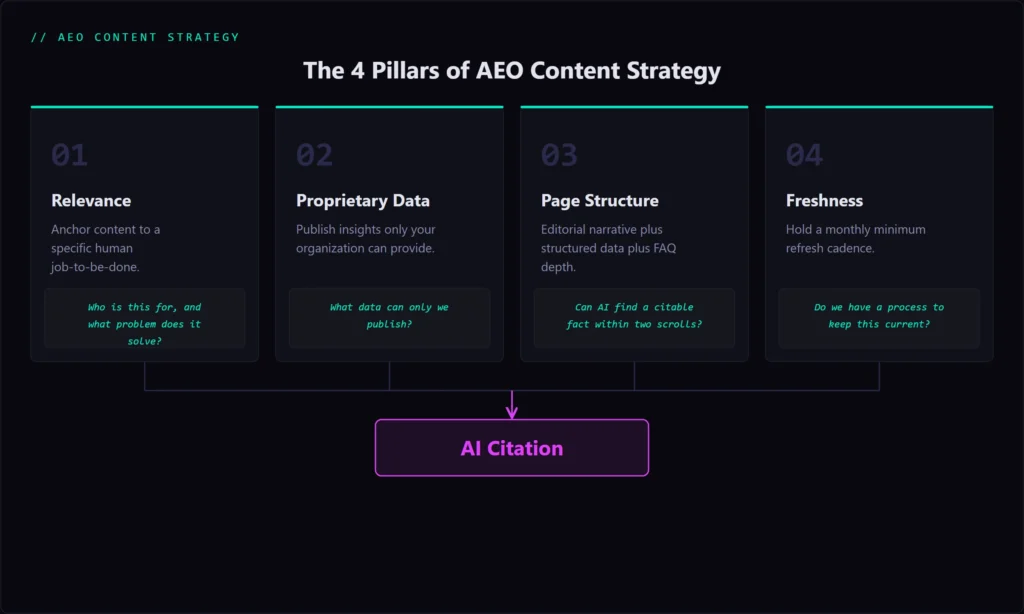
The Four Pillars of an AEO Content Strategy
Key insight
AEO content strategy isn’t about tricking AI models. It’s about giving them what they’re already optimized to find: specific, credible, human-centered content that answers a real question better than anything else on the web.
Pillar 1: Relevance to a Real Human Problem
AI models don’t rank pages. They match queries to the most useful answer for the person asking. If your content doesn’t clearly signal who it’s for and what problem it solves, the model has no reason to surface it.
Ramp learned this the hard way. Their team created deeply detailed content on niche accounts payable topics, genuinely useful subject-matter coverage. The LLMs ignored it. When they audited the pages, the problem was clear: the content was written as topic coverage, not problem resolution. There was no recognizable human need attached to it.
When Ramp went back and reanchored the same content to a specific job: “a finance manager trying to understand vendor price trends before a contract negotiation”, citations came back, with share of voice for those pages increasing roughly 10% within two months. (George Bonaci, Ramp)
The practical test for every piece of content: can you finish this sentence?
“This page helps [specific person] [accomplish specific task] so they can [reach specific outcome].”
If you can’t, the content is topic coverage, not problem resolution. Here’s the difference in practice:
| Thinking in Topics | Thinking in Jobs |
|---|---|
| “Write a page about accounts payable software” | “Help a CFO figure out if AP automation will save them enough time to justify the cost” |
| “Write about business credit cards” | “Help a founder understand what expense limits to set for their team” |
| “Write about 3PL returns processing” | “Help an ops manager explain to their boss why returns are taking too long” |
Pillar 2: Proprietary Data and Original Insight
AI models are trained to cite sources that offer information no one else has. The most powerful AEO signal is data or insight that is uniquely yours.
Ramp’s answer to this was Ramp Rate, a product built not for human consumption but for LLM consumption. They took their transaction data from tens of millions of purchases across 40,000+ customers, ran it through an engine that surfaced spend trends and benchmarks, and published the output in a crawlable, structured format. Session growth to those pages increased approximately 150% after implementation. (George Bonaci, Ramp)
What made it work wasn’t the volume of data, it was the exclusivity. No competitor could publish those benchmarks. No media outlet had access to that transaction history. When AI models encountered a question about software pricing trends or expense benchmarks, Ramp Rate was the only credible, specific, crawlable source. It got cited alongside established media outlets while direct competitors didn’t appear.
The question to ask your organization: What do we know, from operating in this business, that no competitor or media outlet could publish?
Common sources of proprietary data include aggregated customer benchmarks, usage and volume trends, internal performance metrics tracked over time, and original survey results. Even a modest dataset, if it’s unique and published properly, can drive meaningful gains in AI citations.
Pillar 3: Page Structure Optimized for AI Extraction
How a page is structured determines whether an AI model can extract and cite it. Ramp ran structured A/B tests on page anatomy and found that structure was “one of the most important things”, even more than content depth in some cases.
High-performing AEO page structure follows a consistent pattern:
- A clear, problem-anchored headline that signals what job this page addresses
- An editorial narrative, an opinionated interpretation of the data, not a neutral summary
- Structured data or visuals like charts, tables, or statistics that are easy for a model to parse
- FAQ content placed at a depth that signals it’s supplementary, not the core content
- Raw data table: for complex topics, a data table below the narrative dramatically improves machine ingestion
Two elements from this list trip people up. First, the editorial narrative: AI models don’t just want data, they want an opinion. Ramp’s economist added commentary and interpretation to every Ramp Rate page, not just the numbers, but what the numbers mean. Generic summaries don’t get cited; positions do.
Second, FAQ placement matters more than most people realize. Ramp’s testing showed that FAQ depth, how far down the page it sits, has a significant impact on citation rates. FAQs placed too high signal that the FAQ is the content. FAQs placed after the main narrative signal that they’re supplementary, which appears to correlate with higher citation frequency.
The diagnostic question: if an AI model is skimming this page for a citable fact or recommendation, can it find one within the first two scrolls?
One clarification on the phrase “structured data,” since it gets overloaded. In this pillar it means visible, parseable page structure: clear headings, tables, and standalone answers, not schema markup. Schema still matters, but it works upstream at indexing and training time rather than at the moment an AI fetches the page, because most assistants strip your JSON-LD on retrieval. I draw out that distinction in schema markup for AI. If you want a fully parseable copy of your site for agents to read, the free OKF Generator builds one as an Open Knowledge Format bundle.
Pillar 4: Freshness at Scale
Static content loses AI citations over time. Models weight recency, especially for pricing, benchmarks, trends, and market conditions. Ramp built Ramp Rate with automated pipelines specifically to solve this, their data updates as close to real-time as possible, and pages are refreshed at minimum monthly.
The refresh bar is lower than you might think. Even light updates, new statistics, updated figures, revised commentary, are enough to signal recency. Monthly is the floor. Weekly is better for data-driven content.
Scale matters as much as freshness. The more pages you have that meet the first three criteria, the larger your citation surface area. More pages mean more opportunities to appear in AI answers and more data to run experiments with. Ramp’s long-term insight was that Ramp Rate wasn’t just an AEO play, it was an experimentation platform. Thousands of structured pages meant they could test content changes, structure changes, and promotion approaches at a rate their competitors couldn’t match.
The question isn’t just “is this content fresh?” It’s “do we have a process to keep our most important AEO content current, or are we publishing and walking away?” Building that process into your content marketing strategy from the start is the difference between an AEO program that compounds and one that stalls.
The AEO Audit: Where to Start
Before building new content, audit what you already have. Most brands are sitting on underutilized AEO assets that need repositioning, not replacement.
Step 1: Identify your low-volume, high-specificity pages. Pull all pages targeting keywords with fewer than 100 monthly searches. These are the pages traditional SEO tools deprioritize, and they may be exactly what AI models are looking for. Ramp’s first successful experiment started with programmatic content their consultants had written off as a waste of time; a quick refresh and restructure produced significant increases in citations and AI visibility across that content set. (George Bonaci, Ramp) Test them for AI citation performance before you do anything else.
Step 2: Test your AI visibility now. Run your core buyer questions through ChatGPT, Perplexity, and Google AI Overviews. Track whether your brand appears, who does appear, and what type of content is being cited. This gives you a baseline and identifies which competitors are already winning AEO in your category. You can’t close gaps you haven’t mapped.
Step 3: Map content to jobs to be done. Review your existing content library and tag each piece with the specific buyer task or question it addresses. Content that can’t be tagged to a specific job-to-be-done is a candidate for revision or consolidation. Use the sentence test from Pillar 1: “This page helps [person] [do task] so they can [reach outcome].” If you can’t complete it, the page needs reanchoring before it will perform in AI search.
Step 4: Identify your proprietary data assets. Brainstorm what data your organization generates, holds, or could aggregate. What benchmarks do you have access to that a media outlet couldn’t replicate? What usage patterns, volume trends, or performance metrics live inside your business? Even modest datasets, if they’re unique and published properly, can drive meaningful AEO gains. Bonaci’s takeaway: “Every company should probably think about what proprietary, opinionated metrics they have, and figuring that out is probably the fundamental question before you start any of these projects.”
Step 5: Prioritize by citation gap. Where are buyers asking AI questions that you’re not answering, but competitors or media outlets are? Those gaps are your highest-priority content opportunities. A systematic review of AI responses in your category will surface the specific questions you need to own, and reveal the content formats that are already getting cited, so you can build toward what’s working rather than guessing.
What AEO Success Looks Like
AEO is measured differently than traditional SEO. Keyword rankings and organic traffic are lagging indicators here. The metrics that matter:
| Metric | What It Measures |
|---|---|
| Share of Voice (AI) | % of AI responses in your category that mention your brand |
| Citation Rate | How often your pages are cited as a source in AI answers |
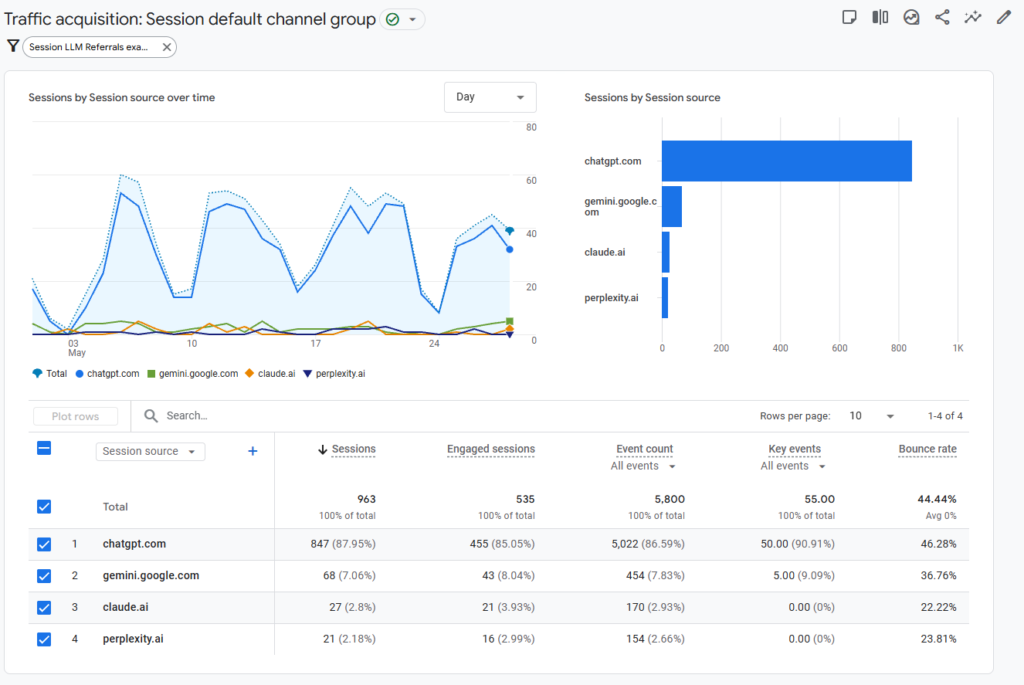
| AI-Driven Sessions | Traffic arriving via AI platforms (ChatGPT, Perplexity, etc.) |
| Mention Sentiment | When AI mentions you, is it positive, neutral, or negative? |
| Competitive Visibility | Your citation rate relative to key competitors |
Start with Share of Voice and Citation Rate. They tell you whether your answer engine optimization framework is working before traffic numbers reflect it. Sentiment matters more than most teams track, being mentioned neutrally or negatively in AI responses can suppress conversion even when you’re getting cited frequently. For a broader look at how LLM SEO connects to measurement and visibility tooling, that post covers the full stack.
Conclusion
The window to establish authority in AI search before your category becomes saturated is open now. The brands that win over the next two to three years will be the ones that act on what Ramp’s experiments proved: specific content tied to real human problems, backed by proprietary data, structured for machine extraction, and kept fresh at scale.
Next Steps
- Run your top five buyer questions through ChatGPT, Perplexity, and Google AI Overviews and document who appears.
- Pull your pages targeting under 100 monthly searches and test them for AI visibility, these are your quick-win candidates.
- Apply the jobs-to-be-done test to your existing content library and flag anything that can’t be tied to a specific buyer task.
- Identify one proprietary data asset your organization holds that no competitor could replicate and plan how to publish it in a crawlable, structured format.
- Set a refresh cadence for your highest-performing AEO pages, monthly at minimum, weekly for data-driven content.
If you’re working through your AEO strategy and want a second perspective, let’s talk.
AEO Audit Checklist
- Identify your low-volume, high-specificity pages (under about 100 monthly searches) and test them for AI citation performance first.
- Test your AI visibility now by running core buyer questions through ChatGPT, Perplexity, and Google AI Overviews and noting who gets cited.
- Map each existing page to a specific job-to-be-done; flag any page that fails the “helps [person] [do task] so they can [reach outcome]” test for revision.
- Identify your proprietary data assets: benchmarks, usage patterns, or metrics only your business can publish.
- Prioritize by citation gap, the buyer questions AI answers with competitors’ or media content but not yours.
Frequently Asked Questions
What is AEO content strategy?
AEO content strategy, Answer Engine Optimization content strategy, is the practice of creating and structuring content so that AI models like ChatGPT, Perplexity, and Google’s AI Overviews cite and recommend your brand in their responses. It differs from traditional SEO in that it optimizes for a single AI-generated answer, not a ranked list of links.
How is AEO different from SEO?
SEO optimizes for ranking positions in a list of results. AEO optimizes for inclusion in a single generated answer. The ranking signals differ: AI models weight specificity, proprietary data, credible sourcing, page structure, and recency more heavily than traditional ranking factors like domain authority or link count.
What kind of content performs best in AI search?
Content that is specific to a real buyer problem, backed by proprietary or first-party data, structured with an editorial narrative and supporting data tables, and kept fresh with regular updates. Generic topic coverage rarely gets cited. Opinionated, specific, problem-anchored content consistently outperforms it.
How do I measure AEO performance?
Track Share of Voice (the percentage of AI responses in your category that mention your brand), Citation Rate (how often your pages are cited as sources), and AI-Driven Sessions (traffic arriving via AI platforms). These metrics reflect AEO performance before traditional traffic numbers move.
Where should I start with AEO if I have limited resources?
Start with what you already have. Audit your low-search-volume pages for AI citation performance; they’re often your best opportunities. Then run your core buyer questions through AI tools to identify where competitors are appearing, and you’re not. Quick content refreshes with a jobs-to-be-done reanchor often outperform building new content from scratch.