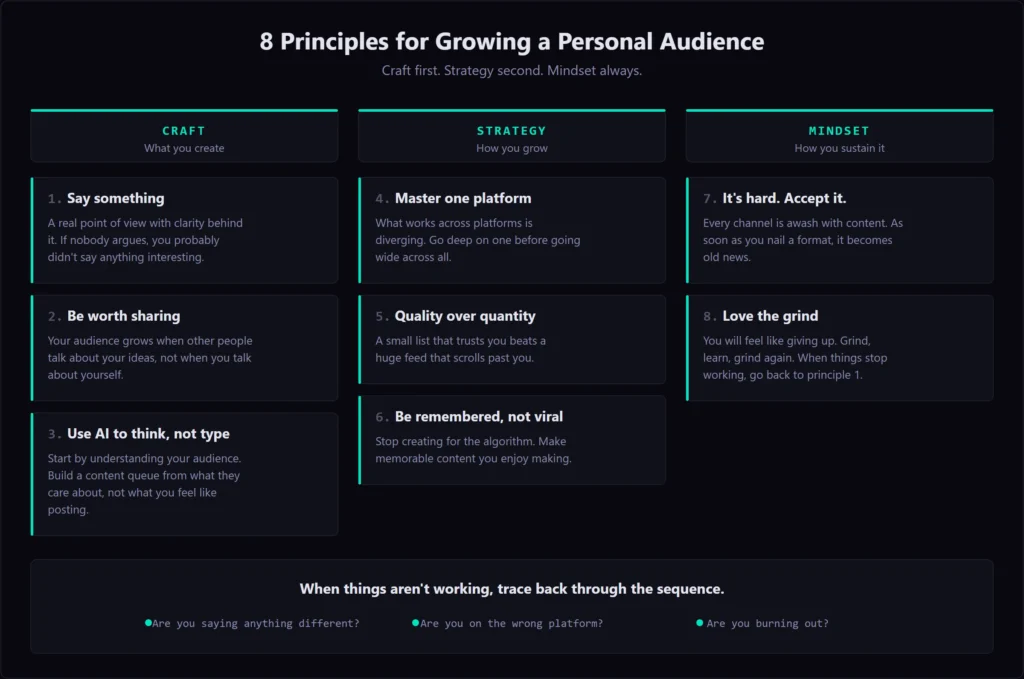
Search “AI content strategy,” and every guide tells you the same thing: use AI to publish more, faster. Spin up ten posts in the time it used to take to write one. That advice is backward. Volume was never the constraint, and now that everyone can manufacture it on demand, volume is the cheapest thing in the room. The leverage is using AI to think harder about who you are writing for and whether what you’re saying is worth saying at all. That is the whole game, and almost nobody is playing it.
This is the AI content strategy I actually run as an SEO consultant. Not ten prompts you can paste into ChatGPT, but the system and the judgment around it. The goal is simple: use AI to think better, not write faster.
Key Takeaways
- Most “AI content strategy” advice optimizes for output. The real gain is using AI to understand your audience and sharpen your argument before you write a word.
- Build an audience profile first: pain points, the language they actually use, and what makes them share. Generate ideas against that, not against a blank prompt.
- Use AI for research and structure; keep the judgment, the opinion, and the final draft human. That split is what keeps the work from sounding like AI.
- Write to be remembered and cited, not to go viral. On a growing share of search results, position one is an AI Overview, so structure for the machine that summarizes you.
- A repeatable process with a human review gate beats raw volume. The gate is the strategy; the AI is the labor.
What an AI content strategy actually is
An AI content strategy is a repeatable system for using AI across the work that surrounds a piece of content: audience research, topic selection, structure, sourcing, and quality control, with a human owning the judgment at every step. Note what is not on that list. Writing the thing is the smallest part, and the part you should guard most carefully.
There are two ways to read the phrase, and the gap between them is the whole article. The first reads AI as a content factory: a machine that turns a keyword into a finished post while you sleep. The second reads it as a thinking layer: a fast, tireless research partner that helps you decide what to make and why, then gets out of the way. The SERP is selling you the first one. The second is the one that works.
Here is why the difference matters more every month. When everyone has the same factory, factory output becomes a commodity, and Google and the AI engines are getting better at recognizing it as one. An AI-driven content strategy wins on the part that the machine cannot do for you: a real point of view, drawn from work you actually did.
Start with the audience, not the prompt
The single biggest mistake in every “AI content strategy” post I read while researching this one: they open the prompt window and type “give me 20 blog post ideas about X.” Garbage in. You get twenty topics that are technically on-subject and completely interchangeable with what your competitors will publish from the same lazy prompt.
Build an audience profile first
Before I let a model anywhere near an idea list, I give it a profile of the person I am writing for. Not a demographic sketch. The useful stuff: what they are actually struggling with, the language they use to describe it, what they already believe, and what they forward to a colleague. I keep these as reusable profiles, built once from real research and real customer language, and the model reads the relevant one before it does anything else.
This is the step that quietly determines everything downstream. An idea generated against a sharp audience profile is aimed. An idea generated against a blank box is a guess.
Generate ideas against the profile, not the void
Watch the difference. “Give me blog ideas about SEO” returns the same listicle skeletons everyone gets. “Given this audience profile, what questions are these people asking that nobody is answering well, and where would my direct experience let me say something the vendor blogs cannot?” returns something I can actually use. The first prompt is creator-first: what do I want to publish? The second is reader-first: what does this specific person need that I am uniquely positioned to give them?
Same tool. Completely different output. The profile is the difference.
Use AI to think, keep the writing human
The line that keeps AI content from reading like AI is simple to state and hard to hold: let AI do the research and the structure, and keep the argument and the prose for yourself. Most of the slop you have learned to spot comes from crossing that line, from letting the machine write the sentence that was supposed to carry your judgment.
Where AI genuinely helps
I lean on it hard for the work that is real but not the point. Pulling apart a SERP and the pages ranking on it. Clustering a messy pile of keywords into themes. Drafting an outline I will then tear up. Finding the gap nobody covered. Pressure-testing an angle by arguing the other side. Tracking down the specific data point I know exists but cannot place. This is genuine leverage, and refusing it out of purism is just slower work for no reward.
Where it has to stay human
Then there is the part that does not get delegated. The opinion. The first-person account of what happened when I tried the thing. The specific number from my own work that no model has access to. The judgment about what to cut. When you hand those to AI, you get content that reads like slop, because the machine did the one part that was supposed to be yours.
Key insight
The fastest way to sound like AI is to let it write the sentence that should have been yours.
Be worth sharing, not just worth publishing
Publishing is not the finish line. A piece earns its place when someone forwards it to a colleague unprompted, not when you push it out and hope.
The blunt version I use is the screenshot test: is there a single line in this draft that someone would screenshot and send to a coworker? If the answer is no, the piece is not finished, no matter how complete it looks. That one quotable line is usually the place where I said something specific and slightly risky, which is exactly the part AI will sand down to safe mush if you let it.
Underneath the test are a few honest reasons people share anything. It makes them look smart for having read it. It validates something they already suspected but had not seen stated plainly. It hands them a framework they can reuse. Or it picks a fight worth having. A draft that does none of those is information, and information is free everywhere now. Run the draft against those before you publish, the same way you would run it against a spell check.
Write to be cited, not just to rank
Here is the distribution reality that should reshape how you structure a post. In the “AI content strategy” search, position one is not a blue link. It is an AI Overview that summarizes a handful of sources into an answer most people will read rather than click. That pattern is spreading across informational queries and changing the target. You are no longer only writing to rank. You are writing to be the source the summary quotes.
Being quotable is not the same as being chosen. When an AI Overview assembles an answer, it pulls from the sources that are easiest to trust and hardest to substitute. In practice, that means three things the factory cannot fake. Specificity: a named number, a real example, a step you can only describe because you did it. Originality: a claim or a dataset that the model cannot already generate on its own, so quoting you is the only way to include it. And a clear entity behind the words, a recognizable author or site, the model has reason to be treated as a source rather than as filler. Generic AI content fails all three at once, which is why it gets summarized past, never cited.
This is also where the whole strategy folds back on itself. You cannot optimize a generic page into a cited one with formatting tricks, because there is nothing in it worth lifting. The structure helps the machine find your point. It cannot manufacture the point. That has to come from the human part you refused to delegate.
That shifts structure in concrete ways. Lead a section with a clean, self-contained answer that the machine can lift. Keep sub-answers under clear headings so they can be pulled out individually. Make claims specific enough to be worth quoting, because a vague sentence is never the one that gets cited. This article is built that way on purpose, which is also why it opens each section with a plain statement before the texture. If you want the deeper version of this, it is its own discipline, and it is most of what it actually takes to get cited in AI Overviews.
The process I actually run
None of the above survives without a process to hold it, and a process is the thing every competitor post leaves out, because isolated prompts are easier to sell than a system. I will keep this directional rather than hand you the exact machine, but the shape matters more than the settings.
It runs as a chain. Research the keyword and the people behind it. Map what already exists, internally and on the SERP, so nothing repeats and the internal links are deliberate. Build a full outline, and stop there for a human read before a single sentence gets written. Draft against that outline. Verify every claim and source. Then put the whole thing through a quality pass that hunts specifically for AI tells, borrowed-sounding phrasing, and sections that read like every other post on the topic. Only then does it publish.
The two pauses are the entire point: one after the outline, one at the quality gate. Those are human, and they are where the strategy actually lives. Everything between them is the AI doing the labor I would otherwise do more slowly. This is the content layer that runs on top of the AI second brain I built, and it is the same discipline I bring to content production for clients.
The honest limit: this is only as good as the discipline around those two gates. Skip them, and you have built a faster way to ship the same slop everyone else is shipping. The system does not save you from bad judgment. It just makes good judgment repeatable.
Quality over quantity, still
The point of all of this is not more posts. It is the fewer, better, more memorable ones that compound over time instead of being scrolled past and disappearing. Be remembered, not viral. Chasing the algorithm burns you out and produces forgettable work, and a smaller audience that trusts you is worth more than a large one that forgets you by lunch.
AI did not change that goal. It changed how cheaply you can do the thinking that was always the actual work. Use the savings to think more, not to publish more. That is the difference between an AI content strategy that builds something and one that just fills a feed, and it is the same idea behind how I compound, not campaign.
AI Content Process Checklist
- Research the keyword and the people behind it.
- Map what already exists internally and on the SERP so nothing repeats and internal links are deliberate.
- Build a full outline, then stop for a human read before a single sentence gets written.
- Draft against the approved outline.
- Verify every claim and source.
- Run a quality pass that hunts for AI tells, borrowed-sounding phrasing, and generic sections, the second human gate.
- Only then publish.
Frequently Asked Questions
What is an AI content strategy?
An AI content strategy is a repeatable system for using AI across the work around a piece of content: audience research, topic selection, structure, sourcing, and quality control, with a human owning the judgment at each step. The strongest versions use AI to decide what to make and why, then keep the actual argument and writing human. The weakest use it to mass-produce posts, which now compete as a commodity.
Should you use AI to write content or to plan it?
Plan and research with it; keep the drafting judgment human. AI is genuinely strong at SERP analysis, keyword clustering, outlining, and finding gaps. It is weak exactly where content earns its keep: a real opinion, first-person experience, and the specific numbers from your own work. Cross that line and the output starts to read like AI, because the machine did the part that was supposed to be yours.
Does AI-generated content rank or get cited in AI Overviews?
It can, but undifferentiated AI output competes as a commodity and increasingly loses. What gets cited in an AI Overview is specific, well-structured, and grounded in something the model cannot generate on its own: direct experience, original data, a clear point of view. Generic AI content rarely clears that bar.
How do you keep AI content from sounding generic?
Four things. Start from a real audience profile instead of a blank prompt. Write the argument yourself. Apply the screenshot test, so at least one line is sharp enough to share. And run a deliberate quality pass that hunts for AI phrasing tells before anything ships. Generic is the default output; it takes a process to beat it out.
Is an AI content strategy worth it for a solo operator or a small team?
That is where it pays off most. A system that holds your audience research, your conventions, and your standards lets one person operate with the context a whole team would otherwise carry. The constraint for solos was never ideas; it was the hours to do the thinking well. That is exactly the hour an AI content strategy gives back.